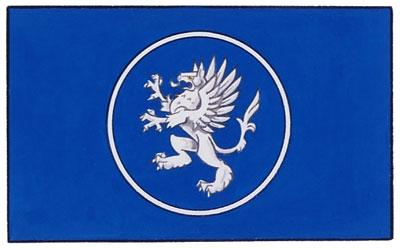

 Arms of The Justice Institute of British Columbia
Arms of The Justice Institute of British Columbia
Blazon
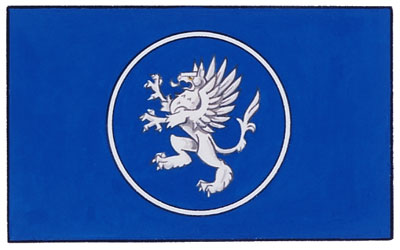
Azure within an annulus a griffin segreant Argent;
Symbolism
Blue and white are the historic colours of the Institute. A single circle is representative of the work of the Justice Institute in several ways: the circle of justice, including the use of the circle when practicing restorative justice; the circle of response to personal or natural crises by all of the agencies represented at the Justice Institute; and the unity of approach by, and collaboration within, the Justice Institute. It also represents community and the Institute's connection to the communities it serves. Since classical times, the griffin has been a symbol of justice, and so it represents the purpose of the Justice Institute and its components, which provide education and training in the areas of study of justice and public safety. Its blend of the features of the eagle and lion alludes to the Institute's focus on multi-agency responses.
Crest of The Justice Institute of British Columbia
Blazon
A griffin passant Azure holding in its dexter claw a conifer Vert eradicated Or;
Symbolism
The griffin repeats the symbolism of the arms, and the tree represents knowledge. The choice of a conifer reflects the Institute's roots in British Columbia. It symbolizes growth and re-energizing through continuous improvement. The nine roots represent the Institute's academic specialties.
Motto of The Justice Institute of British Columbia
Blazon
JUSTICE • SAFETY • COMMUNITY;
Symbolism
JUSTICE SAFETY COMMUNITY are predominant themes in the Institute's mission.
Supporters of The Justice Institute of British Columbia
Blazon
Dexter a Kermode bear (Ursus americanus Kermodie) proper gorged with a collar of maple leaves Or and standing on a grassy mound Vert, sinister an orca (Orcinus orca) gorged with a collar of dogwood flowers proper and rising from a base wavy Argent charged with two bars wavy Azure;
Symbolism
The compartment symbolizes the land and waters of the Province. This theme of the majesty of the provincial landscape and its resources is continued with the supporters. The Kermode bear and the orca are both rare and unique, the former representing strength, stability and remote outreach for the Institute's learners. Just as the Institute receives international interest from visiting delegations, so too is there considerable international interest in these animals. The maple leaf and dogwood collars underscore the Institute's place as a provincial and national institution.