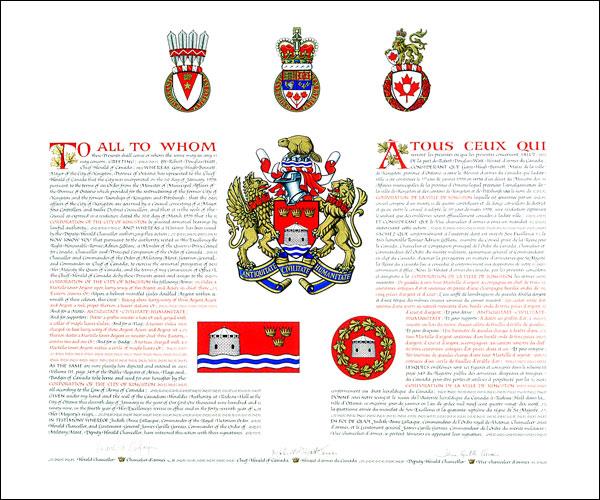
 Arms of the Corporation of the City of Kingston
Arms of the Corporation of the City of Kingston
Blazon
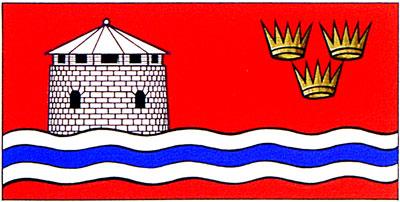
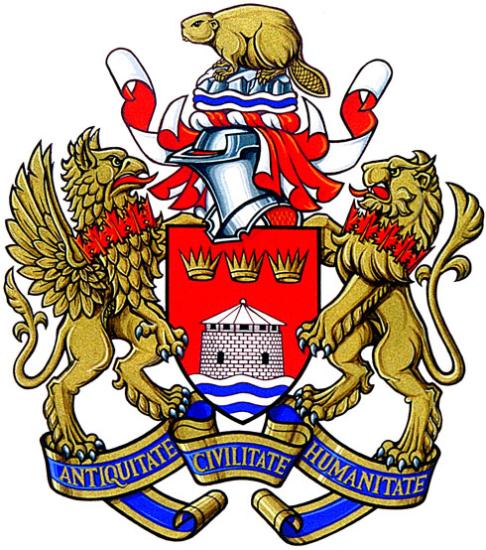
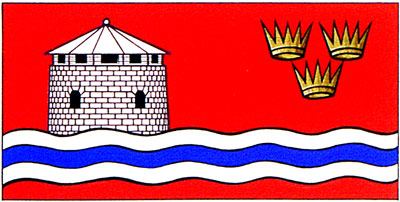
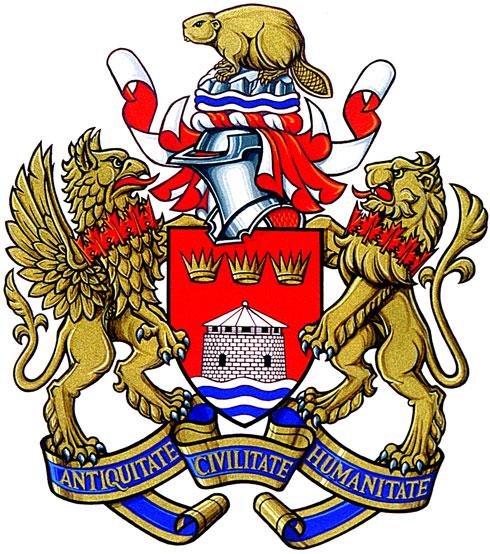
Gules a Martello tower Argent upon barry wavy of five Argent and Azure in chief three Eastern crowns Or;
Symbolism
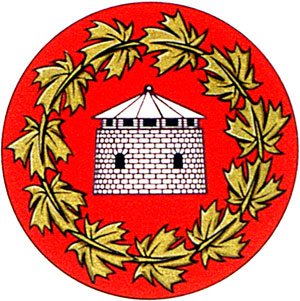
The Martello Tower represents the four such towers built as military fortifications along Kingston’s harbour in the 1840s, thus referring to the city’s military heritage. The crowns allude to the city’s name (“King’s town”) and represent the three municipalities (the City of Kingston, Kingston Township and Pittsburgh Township) that amalgamated in 1998 to form the current city. The waves represent the confluence of Lake Ontario, the St. Lawrence River and the Cataraqui River/Rideau Canal system.
Crest of the Corporation of the City of Kingston
Blazon
Rising above barry wavy of three Argent Azure and Argent a rock proper thereon a beaver statant Or;
Symbolism
The beaver, found on the city’s seal dating from 1853, symbolizes the importance of the fur trade at the time of Fort Cataraqui, founded in 1673 by the Comte de Frontenac, Governor of New France. The rock refers to Cataraqui, derived from the Mohawk word katarokwi, meaning “a place where there is clay or limestone.” The rock also alludes to the city’s limestone fortifications and buildings.
Motto of the Corporation of the City of Kingston
Blazon
ANTIQUITATE CIVILITATE HUMANITATE;
Symbolism
This Latin phrase, literally meaning “Through the ages with civility and humanity,” has been in use by the City for several decades, with the translation “A civil and creative community with a proud past.”
Supporters of the Corporation of the City of Kingston
Blazon
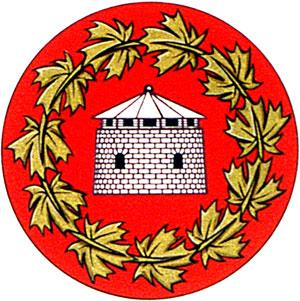
Dexter a griffin sinister a lion Or each gorged with a collar of maple leaves Gules;
Symbolism
The griffin alludes to the griffin claws on the arms of the Comte de Frontenac, thus referring to the French heritage of Kingston. The lion, used as a supporter for the city’s 1899 arms, refers to its British heritage. As one of the supporters of the Royal Arms of Canada, it refers to Kingston’s status as the capital of the province of Canada from 1841 to 1844. The maple leaves represent Canada.