 Arms of the District of Sooke
Arms of the District of Sooke
Blazon
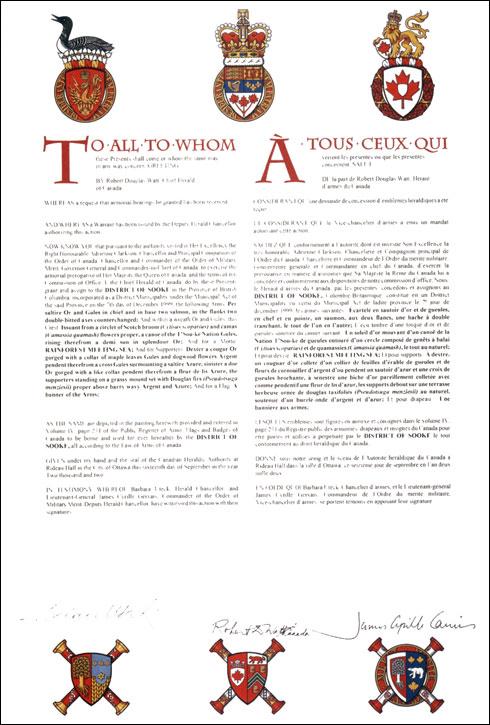
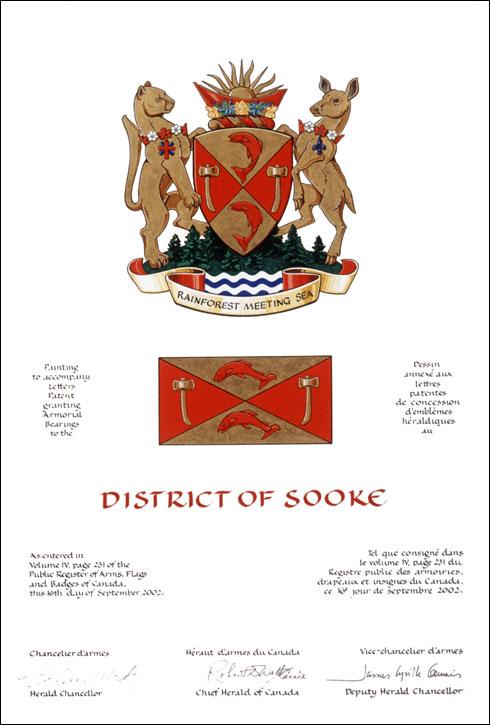
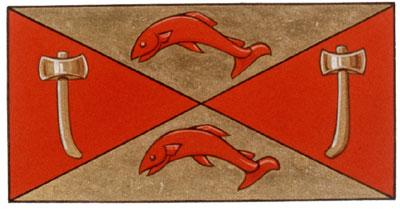
Per saltire Or and Gules in chief and in base two salmon, in the flanks two double-bitted axes counterchanged;
Symbolism
The axes and salmon refer to the historical importance that the industries of forestry and fishing have had in Sooke. Red and gold are the colours of Spain and hence allude to the first European contact. The gold can also refer to the wealth derived from Sooke's traditional industries, as well as to the Leech River gold rush. The diagonal division of the shield makes an allusion to the flag of Scotland and thus to Captain Grant, the first European settler.
Crest of the District of Sooke
Blazon
Issuant from a circlet of Scotch broom (Cytisus scoparius) and camas (Camassia quamash) flowers proper, a canoe of the T'Sou-ke Nation Gules, rising therefrom a demi sun in splendour Or;
Symbolism
The canoe honours the T'Sou-ke Nation, while the sun refers to the sunset over the ocean as well as the sun in the flag of British Columbia. The camas was an important flower to the First Nations, and the broom is a Scottish plant, again referring to Captain Grant.
Motto of the District of Sooke
Blazon
RAINFOREST MEETING SEA;
Symbolism
A shortened version of "Where the rainforest meets the sea," a description of Sooke's geography.
Supporters of the District of Sooke
Blazon
Dexter a cougar Or gorged with a collar of maple leaves Gules and dogwood flowers Argent pendent therefrom a cross Gules surmounting a saltire Azure, sinister a doe Or gorged with a like collar pendent therefrom a fleur-de-lis Azure, the supporters standing on a grassy mound set with Douglas firs (Pseudotsuga menziesii) proper above barry wavy Argent and Azure;
Symbolism
The compartment is a visual representation of the theme "Where the rainforest meets the sea." The cougar and deer are important native animals. Each collar identifies Sooke as being a Canadian municipality in British Columbia. The pendent crosses are of England and Scotland, representing Sooke's British settlers, while the fleur-de-lis refers to French Canadian settlers.