
 Arms of Thomas Andrew Ruggle
Arms of Thomas Andrew Ruggle
Blazon
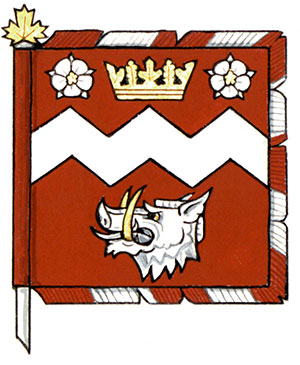
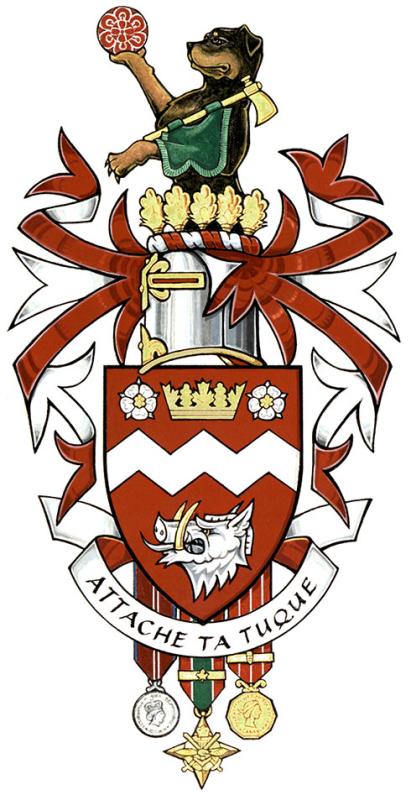
Gules a bar dancetty enhanced Argent between in chief a Loyalist civil coronet Or between two roses Argent seeded Or and in base a boar’s head erased Argent armed Or;
Symbolism
The boar’s head represents Lieutenant-Colonel Ruggle’s long experience as a member, and now commanding officer, of the Lorne Scots (Peel, Dufferin and Halton Regiment), which uses the boar’s head—the crest of the Duke of Argyll—as a collar badge. The Loyalist civil coronet commemorates LCol Ruggle’s descent from the Loyalist Caleb Powell. The ragged white line represents the mountains in Afghanistan where LCol Ruggle was deployed. The roses allude to the Swiss origins of the Ruggle family, and more specifically to the village of Bischofszell and its annual festival of roses.
Crest of Thomas Andrew Ruggle
Blazon
A demi-Rottweiler proper issuant from a circlet of hackles holding in its dexter paw a torteau charged with a mandala Argent and supporting in its sinister leg a pipe tomahawk Or pendent therefrom a pipe banner Vert;
Symbolism
The dog evokes the Ruggle family’s long-time ownership of Rottweiler dogs. The pipe tomahawk, containing symbols of war and peace, recalls that LCol Ruggle presented such items as distinctively Canadian gifts to foreign dignitaries during peace support operations when he was deployed in Afghanistan. The gold hackles are part of the uniform of the Lorne Scots. The pipe banner is an item that contains the personal heraldic emblems of a regiment’s commanding officer. The geometric design is a mandala, often used for meditative purposes, and evokes the Indian heritage of his late wife Sarika Sehgal.
Motto of Thomas Andrew Ruggle
Blazon
ATTACHE TA TUQUE;
Symbolism
This well-known Quebec French phrase means “Get ready.” LCol Ruggle learned it when deployed in Afghanistan with the Royal 22e Régiment.


