 Arms of George Lester Tuccaro
Arms of George Lester Tuccaro
Blazon
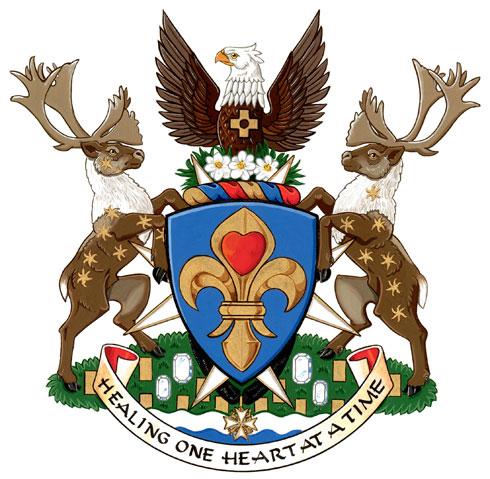
Azure a fleur-de-lis Or charged in chief with a heart Gules;
Symbolism
The blue, red and yellow colours are taken from the coat of arms and the flag of the Northwest Territories, of which Mr. Tuccaro is Commissioner. The fleur-de-lis alludes to Mr. Tuccaro’s French heritage from his mother. The heart represents members of the community and connects to the motto.
Crest of George Lester Tuccaro
Blazon
Issuant from a nest of mountain avens, a demi-bald eagle displayed proper charged on its breast with a cross pierced Or;
Symbolism
The eagle honours the Mikisew Cree, Mr. Tuccaro’s heritage from his father. The cross represents his faith. The mountain avens is the territorial flower. The three flowers symbolize Mr. Tuccaro and his brother and sister.
Motto of George Lester Tuccaro
Blazon
HEALING ONE HEART AT THE TIME;
Symbolism
HEALING ONE HEART AT THE TIME expresses the idea that a community is healed one heart at a time.
Supporters of George Lester Tuccaro
Blazon
Two caribou bulls proper the dexter charged with nine estoiles and the sinister with seven estoiles Or, both standing on a grassy mount Vert billetty Or charged with four gemstones Argent above barry wavy Argent and Azure;
Symbolism
The caribou represent a traditional source of sustenance. The nine stars on the dexter supporter allude to the constellation Capricornus to represent the astrological symbol of Mrs. Tuccaro, and the seven stars on the sinister allude to the star cluster of Pleiades that is found in the constellation Taurus. Cree mythology speaks of their people coming to Earth from the seven stars in spirit form first and then becoming flesh and blood. The compartment is inspired by part of the field of the Arms of the Northwest Territories. The two larger gemstones symbolize Mr. Tuccaro’s children and the two smaller ones his grandchildren.
The wavy bars, representing the Mackenzie River, allude to the importance of sustainable development and sharing land “as long as the sun shines, rivers flow and the grass grows”, a traditional expression that appears in the treaty declaration signed by the Mikisew Cree in 1898 and also in the 1692 presentation of the Two Row Wampum belt, known as Gustwenta.

