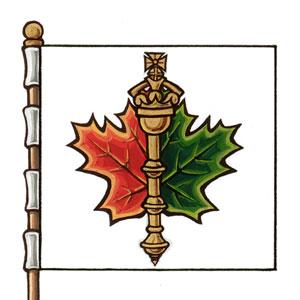
 Arms of the Canadian Association of Sergeants-at-Arms
Arms of the Canadian Association of Sergeants-at-Arms
Blazon
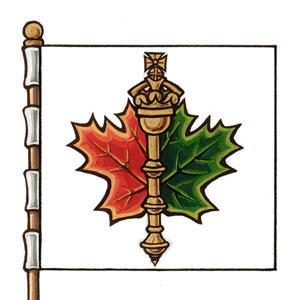
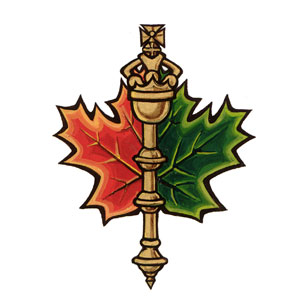
Argent a maple leaf per pale Gules and Vert surmounted by a parliamentary mace Or;
Symbolism
The parliamentary mace indicates the role of Sergeant-at-Arms as officers of parliament. The maple leaf identifies the national mandate of the association, and the red and green colours are traditionally associated with upper and lower houses of parliament in the Westminster tradition.
Crest of the Canadian Association of Sergeants-at-Arms
Blazon
An owl wings elevated and addorsed, charged on the wing with the Royal Crown proper;
Symbolism
The owl symbolizes wisdom and watchfulness. The Royal Crown indicates the close connection the members of the association have with the Crown in Canada.
Motto of the Canadian Association of Sergeants-at-Arms
Blazon
SUSTINIMUS PACEM • ORDINEM • BONUM REGIMEN;
Symbolism
Meaning “We uphold peace, order and good government”, this Latin motto emphasizes the role the members of the association have in upholding the principles of constitutional governance in Canada. It also alludes to a famous phrase used in Section 91 of the Constitution Act, 1867 (originally the British North America Act).
Supporters of the Canadian Association of Sergeants-at-Arms
Blazon
Dexter a black bear supporting on its shoulder the mace of the Senate of Canada, sinister a muskox supporting on its shoulder the mace of Nunavut, both standing on a mount of snow emerging therefrom tufts of grass proper;
Symbolism
The bear, an animal famously protective of its young, is found across Canada. The muskox is an animal of the Canadian north, and is known for protecting its herd. They carry the oldest and newest parliamentary maces currently in use in Canada. The base represents Canadian terrain in summer and winter. The grass emerging from the snow symbolizes rebirth and the cycle of life: the clumps of grass indicate the legislative houses in Canada: one in each of the provinces and territories, plus the two federal houses.