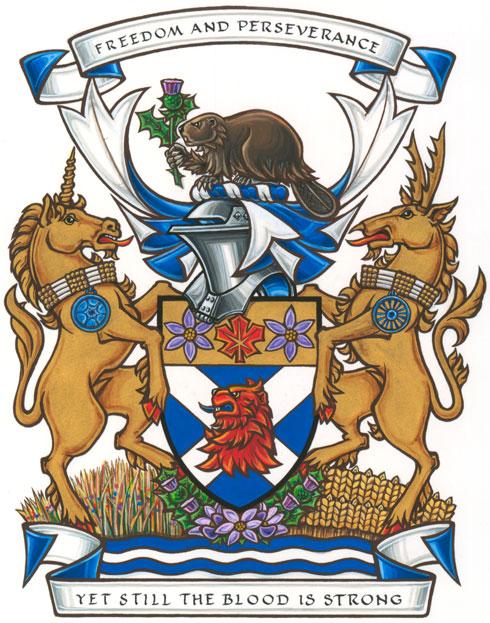
 Arms of The St. Andrew's Society of Winnipeg
Arms of The St. Andrew's Society of Winnipeg
Blazon
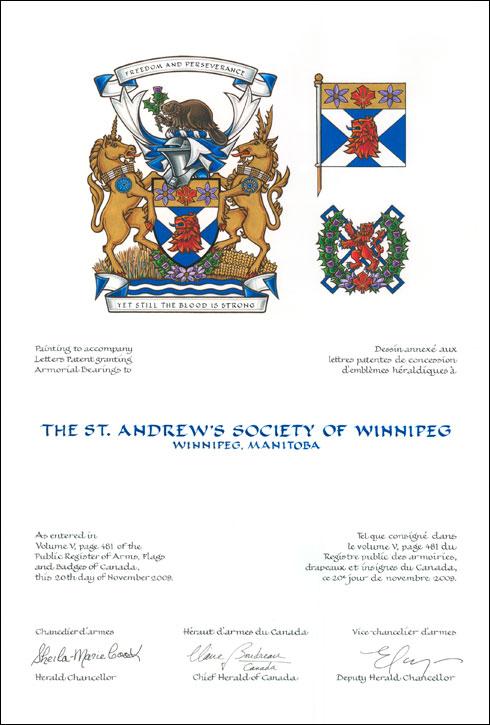
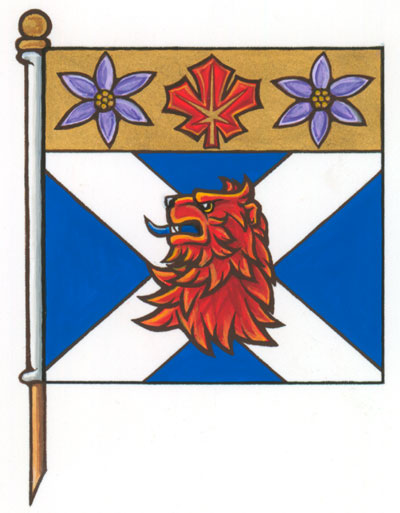
Azure a saltire Argent overall a lion’s head Gules, on a chief Or a maple leaf Gules between two prairie crocuses proper;
Symbolism
The white saltire on blue is the cross of St. Andrew, and refers to the Society’s name. The prairie crocus flower is the provincial flower of Manitoba and appears in the arms of the city of Winnipeg. The maple leaf is a Canadian symbol, and the red lion’s head refers to the rampant lion in the royal arms of Scotland. The two main background colours, blue and yellow, are also those of the flag of Winnipeg.
Crest of The St. Andrew's Society of Winnipeg
Blazon
A beaver couchant holding in the dexter paw a thistle proper;
Symbolism
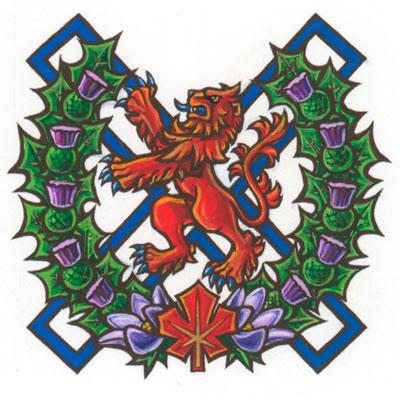
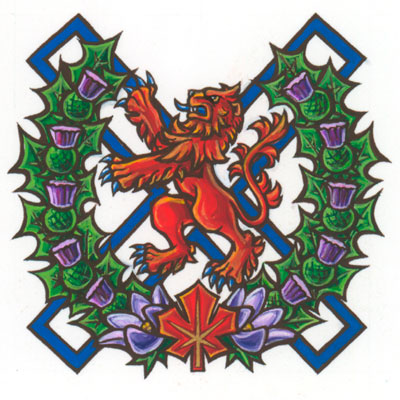
The beaver is a Canadian symbol and recalls the importance of the fur trade, which brought many Scots to western Canada. Four beavers also appear in the armorial bearings of the Hudson’s Bay Company, and one in the crest of Lord Strathcona, the first President of the Society. The thistle is the national floral emblem of Scotland and appears in the Society’s badge.
Motto of The St. Andrew's Society of Winnipeg
Blazon
FREEDOM AND PERSEVERANCE;
Symbolism
FREEDOM AND PERSEVERANCE is a variation of Lord Strathcona’s motto, “Perseverance”. It also recalls the provincial motto, which means “Glorious and free”.
Motto of The St. Andrew's Society of Winnipeg
Blazon
YET STILL THE BLOOD IS STRONG;
Symbolism
YET STILL THE BLOOD IS STRONG is taken from the “Canadian Boat Song”, published anonymously in 1829 and which has its roots with Scots in the early fur trade. It refers to the enduring heritage of the Scots in Winnipeg.
Supporters of The St. Andrew's Society of Winnipeg
Blazon
Dexter a unicorn Or gorged with a Salteaux beaded headband proper pendent therefrom a Viking shield Azure, sinister an antelope Or gorged with a like headband pendent therefrom a cartwheel Azure, both standing on a mount of prairie crocuses and thistles between prairie grass and wheat proper and issuant from barry wavy Azure and Argent;
Symbolism
The unicorn is a supporter of the arms of Scotland, Canada and Manitoba. The antelope is a supporter of the arms of the Earl of Selkirk, who brought Scottish settlers to what is now the Red River region. The supporters are shown with beaded headbands, a tribute to the original inhabitants of the area, who came to the aid of the Selkirk settlers and who were vital participants in the fur trade. The Viking shield refers to the Orkney and Shetland Islands, the region of origin of many Scots who settled in the Red River area. The Red River cartwheel recalls the Scottish settlers in that region.
The compartment refers to the fertile grounds of the Red River valley and the transformation of the tall prairie grass to cropland, begun by the Selkirk settlers in 1812. The thistles and the prairie crocuses are taken from the Society’s badge. The stylized water alludes to the settlement of the Red River and the transportation routes of the fur trade.