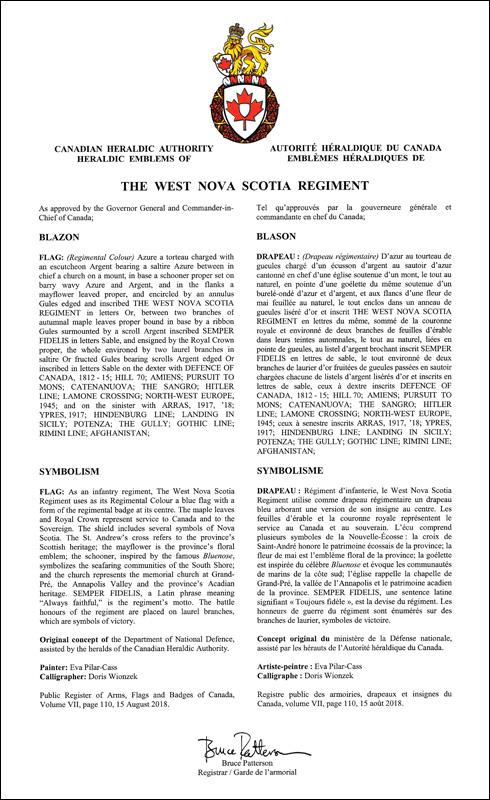
Regimental Colour of The West Nova Scotia Regiment
Regimental Colour of The West Nova Scotia Regiment
Blazon
(Regimental Colour) Azure a torteau charged with an escutcheon Argent bearing a saltire Azure between in chief a church on a mount, in base a schooner proper set on barry wavy Azure and Argent, and in the flanks a mayflower leaved proper, and encircled by an annulus Gules edged and inscribed THE WEST NOVA SCOTIA REGIMENT in letters Or, between two branches of autumnal maple leaves proper bound in base by a ribbon Gules surmounted by a scroll Argent inscribed SEMPER FIDELIS in letters Sable, and ensigned by the Royal Crown proper, the whole environed by two laurel branches in saltire Or fructed Gules bearing scrolls Argent edged Or inscribed in letters Sable on the dexter with DEFENCE OF CANADA, 1812 - 15; HILL 70; AMIENS; PURSUIT TO MONS; CATENANUOVA; THE SANGRO; HITLER LINE; LAMONE CROSSING; NORTH-WEST EUROPE, 1945; and on the sinister with ARRAS, 1917, ’18; YPRES, 1917; HINDENBURG LINE; LANDING IN SICILY; POTENZA; THE GULLY; GOTHIC LINE; RIMINI LINE; AFGHANISTAN;
Symbolism
As an infantry regiment, The West Nova Scotia Regiment uses as its Regimental Colour a blue flag with a form of the regimental badge at its centre. The maple leaves and Royal Crown represent service to Canada and to the Sovereign. The shield includes several symbols of Nova Scotia. The St. Andrew’s cross refers to the province’s Scottish heritage; the mayflower is the province’s floral emblem; the schooner, inspired by the famous Bluenose, symbolizes the seafaring communities of the South Shore; and the church represents the memorial church at Grand-Pré, the Annapolis Valley and the province’s Acadian heritage. SEMPER FIDELIS, a Latin phrase meaning “Always faithful,” is the regiment’s motto. The battle honours of the regiment are placed on laurel branches, which are symbols of victory.