 Arms of Alexandra Alexandrova Fol
Arms of Alexandra Alexandrova Fol
Blazon
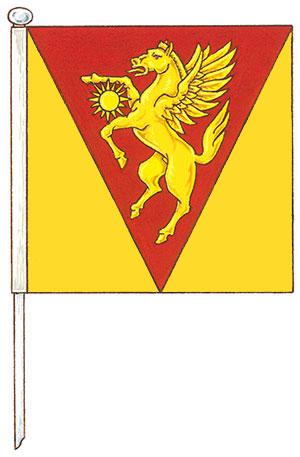
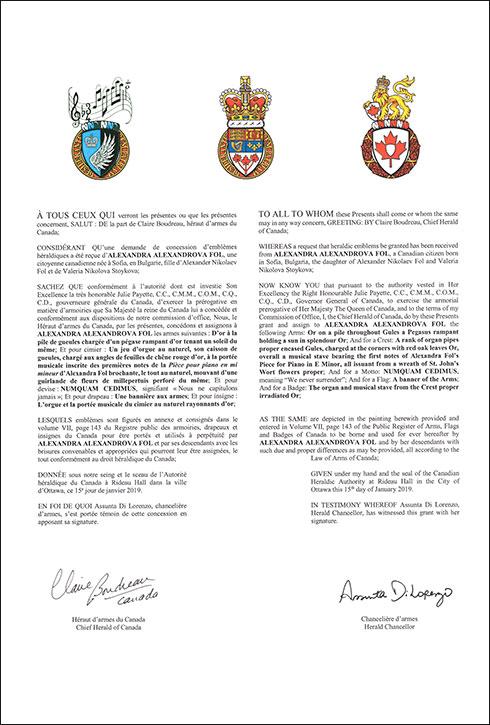
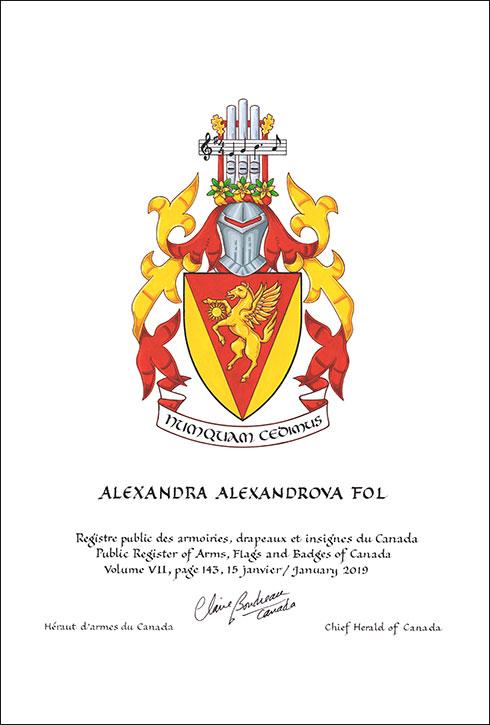
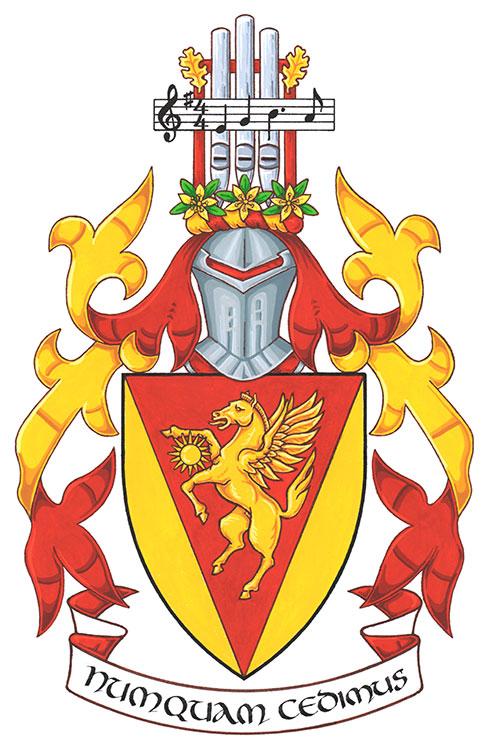
Or on a pile throughout Gules a Pegasus rampant holding a sun in splendour Or;
Symbolism
Yellow and red represent light and vitality, as does the sun. These are important concepts in Thracian Orphism, the ancestral religion observed by Dr. Fol’s family. This was the religion of the Thracian people that inhabited Dr. Fol’s native Bulgaria. The downward-pointed triangle is a symbol of the Mother Goddess in the Orphic religion. The Pegasus is an important cultural symbol for the Thracians, and occurs frequently in their art.
Crest of Alexandra Alexandrova Fol
Blazon
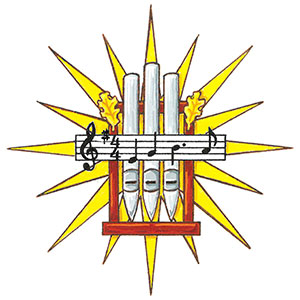
A rank of organ pipes proper encased Gules, charged at the corners with red oak leaves Or, overall a musical stave bearing the first notes of Alexandra Fol’s Piece for Piano in E minor, all issuant from a wreath of St. John’s Wort flowers proper;
Symbolism
The organ pipes represent Dr. Fol’s career as an organist, a composer and a musicologist. The musical notation is the first bar of the first piece that Dr. Fol composed, at the age of five, and which marked the beginning of her lifelong career as a musician. The oak, here represented by its leaves, is a sacred tree for the Thracians, namely for the Odryssian people, who saw it as representing the vertical structure of the universe reaching from the world of the dead to the world of the gods. It grows both in Canada and in Bulgaria, Dr. Fol’s two homelands. St. John’s wort was considered an important healing plant by the Thracians.
Motto of Alexandra Alexandrova Fol
Blazon
NUMQUAM CEDIMUS;
Symbolism
This Latin phrase is derived from Dr. Fol’s Bulgarian family motto, and means “We never surrender.”