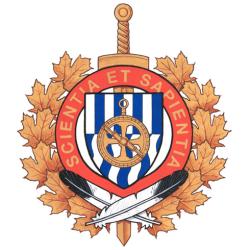
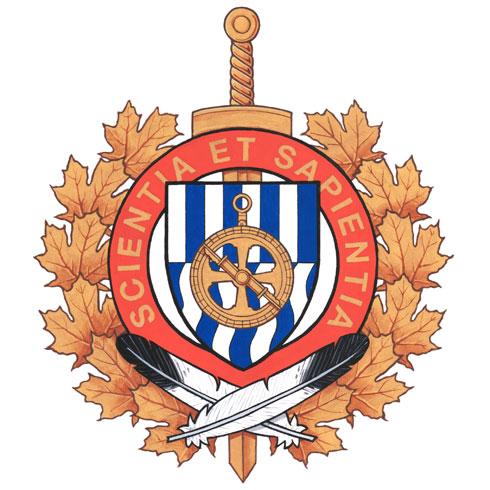
 Badge of the Canadian Museum of History
Badge of the Canadian Museum of History
Blazon
The shield of the Arms of the Canadian Museum of History as confirmed in Volume VI, page 714 (Per fess Argent and Azure and paly wavy counterchanged, overall an astrolabe Or), encircled by an annulus Gules inscribed SCIENTIA ET SAPIENTIA, meaning “Knowledge and wisdom”, in letters Or, the whole set on a sword palewise point downwards environed by a wreath of maple leaves Or, overall in base two eagle feathers in saltire proper;
Symbolism
The vertical lines evoke the Chaudières Falls, which French explorer Samuel de Champlain described in 1613 during his travel up the Ottawa River, near the current site of the Canadian Museum of History. The water symbolizes the country’s natural resources in addition to recalling the importance of waterways, for centuries the main trade and communication routes for both the Indigenous peoples and European settlers. The astrolabe, a symbol of European exploration, represents the instrument in the museum’s collection believed to have been lost by Champlain on his journey to the country of the Huron.
While the shield represents more specifically the Canadian Museum of History, the sword, a military symbol, alludes to the Canadian War Museum, which operates as an affiliate. The eagle feathers are a symbol of Indigenous peoples and honour the first inhabitants of the region. The maple leaves symbolize Canada.
Motto of the Canadian Museum of History
Blazon
SCIENTIA ET SAPIENTIA;
Symbolism
This Latin phrase means “Knowledge and wisdom”.
