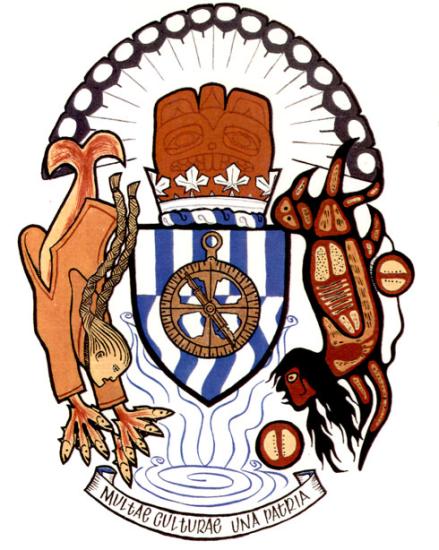
 Arms of the Canadian Museum of Civilization
Arms of the Canadian Museum of Civilization
Blazon
Paly Argent and Azure per fess paly wavy counterchanged overall a representation of the astrolabe of Samuel de Champlain Or;
Symbolism
The vertical lines evoke the Chaudières Falls, which French explorer Samuel de Champlain described in 1613 during his travel up the Ottawa River, nearby the current site of the Canadian Museum of History. The water symbolizes the country’s natural resources in addition to recalling the importance of waterways, for centuries the main trade and communication routes for both the Indigenous peoples and European settlers. The astrolabe, a symbol of European exploration, represents the instrument in the museum’s collection believed to have been lost by Champlain on his journey to the country of the Huron.
Crest of the Canadian Museum of Civilization
Blazon
A coronet of maple leaves Argent a representation of a copper displaying the beaver crest of Chief Ninstints of the Haida people framed with a corona of eagle feathers all Proper;
Symbolism
A traditional symbol of Canada noted for its industrious skills, the beaver was a major family emblem of Pacific Coast First Nations. This beaver image is taken from a ceremonial copper in the collection of the museum bearing the mark of Chief Ninstints, of the Haida people. The fan of eagle feathers is a traditional symbol of honour of the Plains First Nations. The maple leaf is one of Canada’s national emblems.
Motto of the Canadian Museum of Civilization
Blazon
MULTAE CULTURAE UNA PATRIA;
Symbolism
This Latin phrase, meaning “Many cultures one country”, recalls the museum’s mandate to preserve and promote the cultural traditions which define Canadians.
Supporters of the Canadian Museum of Civilization
Blazon
Dexter a representation of the Inuit underwater Spirit Sedna her finger joints producing fish styled by Manasie Akpaliapik sinister a representation of the Algonquian Michipijeu by the name Asticou styled by Norval Morrisseau, both spirits diving into a whirlpool all Proper;
Symbolism
On the left, Sedna, the guardian of sea animals in Inuit culture, represents the First Peoples of Canada’s North; she is styled after a work by Inuit artist Manasie Akpaliapik. On the right, Asticou, an Algonquian merman said to live below the Chaudières Falls, represents the First Nations of Eastern Canada; he is styled after a work by Anishinaabe artist Norval Morrisseau. Both spirits are depicted diving into a whirlpool, which represents the power of nature in its elemental state.
